Environmental Impact of Water Softeners: Are They Eco-Friendly?
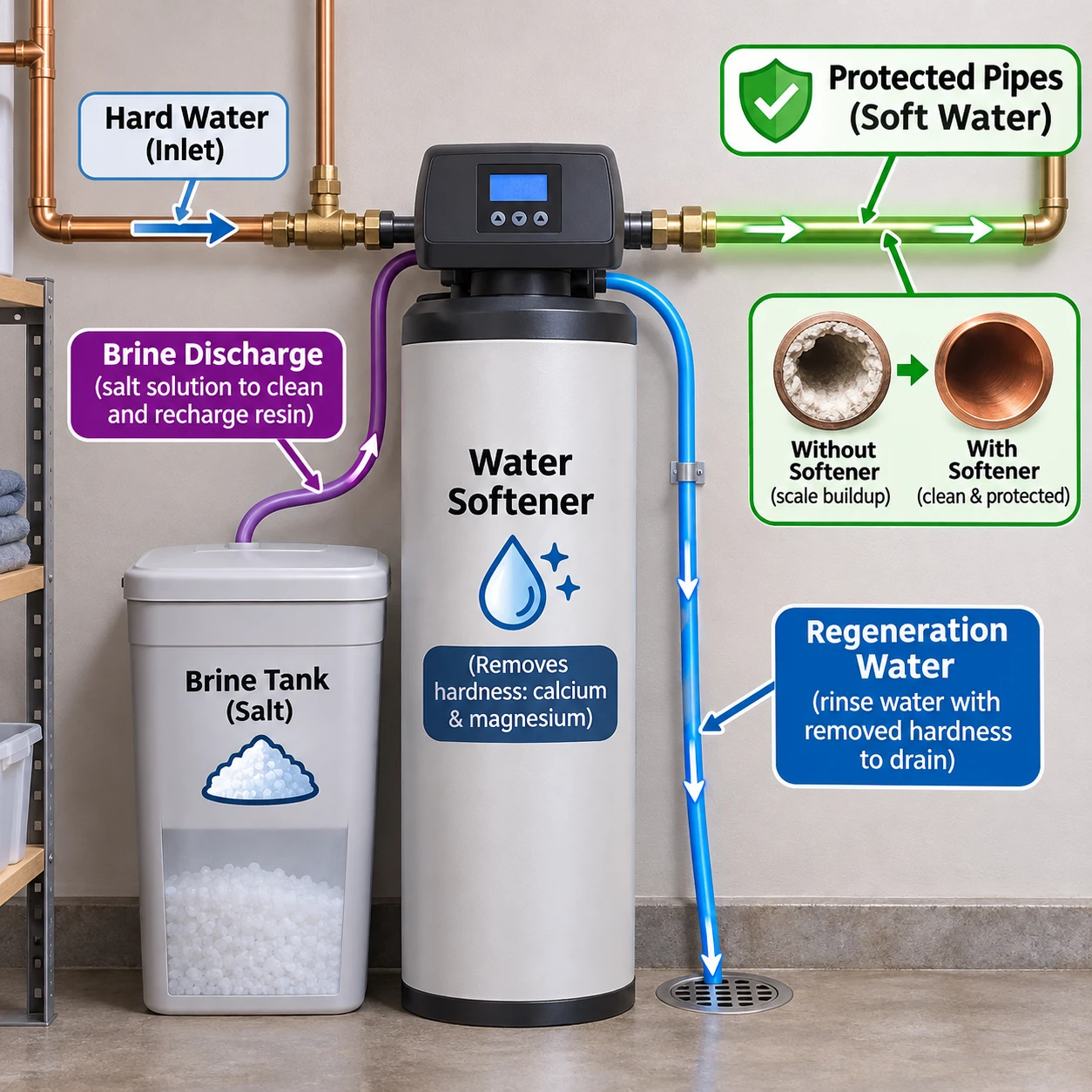
Water softeners can reduce limescale in plumbing and appliances, but salt-based systems also use water and send concentrated brine into a drain. Whether a water softener is eco-friendly depends on your water conditions, the equipment and settings, and how local wastewater systems handle that discharge.
How water softeners work
A salt-based water softener removes hardness minerals, mainly calcium and magnesium, through ion exchange. It later flushes those minerals from its resin with sodium chloride brine, a process called regeneration that uses both salt and water.
Hard water is not generally a health hazard, but its minerals can form scale on heating elements, pipes, taps, and other surfaces. In an ion-exchange softener, water passes through a tank containing resin beads. The beads hold sodium ions and exchange them for calcium and magnesium ions in the water.
As the resin fills with hardness minerals, it needs regeneration. The unit draws a brine solution from its salt tank, rinses the resin, and sends the resulting wastewater to a drain. The system then returns to service. The amount of salt and water used varies by model, household demand, water hardness, and control settings.
That regeneration cycle is the main environmental trade-off. A softener that regenerates based on actual water use can avoid unnecessary cycles; a poorly configured timer-based unit may regenerate when it does not need to.
Environmental costs of salt-based softeners
Salt-based water softeners have three main environmental costs: they consume sodium chloride, use water during regeneration, and discharge brine containing sodium and hardness minerals. The significance of those costs depends on the system and the destination of the wastewater.
Brine discharge can matter because wastewater treatment plants are not all designed to remove dissolved salts. In some places, salt reaching surface water or groundwater can affect freshwater ecosystems, while high salinity in wastewater may complicate treatment or reuse. Local rules may restrict discharges from water softeners, so check with your water utility or wastewater authority before installation, especially if you use a septic system.
Regeneration also adds water to household wastewater. How much depends on the softener’s design and settings, so there is no single figure that applies to every home. Excessive regeneration wastes both water and salt; too little regeneration can leave the resin unable to soften water effectively.
Salt is another consideration. The sodium chloride used for regeneration does not simply disappear: it enters the brine and is flushed away with the minerals removed from the resin. Brine should go to an approved drain, not a storm drain, yard, or nearby waterway. Those routes can carry salty wastewater directly into places where it may cause harm.
For guidance about wastewater and household systems, consult your local authority. The U.S. Environmental Protection Agency’s information on septic systems explains why protecting onsite wastewater systems and following local requirements matter.
Potential benefits of softening water
Softening hard water can reduce mineral scale in pipes, water heaters, and appliances that use hot water. By helping equipment operate as intended, it may reduce maintenance or early replacement, although the environmental benefit is not guaranteed and varies by home.
Scale can build up on heating surfaces and inside plumbing. Removing hardness minerals from water can limit that buildup, which may help keep some equipment working effectively. A softener can also reduce mineral deposits on fixtures and make soap lather more readily, so some households use less descaling product or detergent. The amount saved depends on existing water conditions and how people change their cleaning habits.
These benefits should not be overstated. A softener does not generate energy savings by itself, and it cannot fix every cause of poor appliance performance. The outcome depends on hardness, appliance design, maintenance, and the system’s efficiency. If your water is only slightly hard, the environmental costs of installing and operating a salt-based unit may outweigh its practical value.
Think of softening as a targeted response to a measured water problem. A hardness test can help establish whether scale is likely to be a concern before you buy equipment. If you already have a softener, check whether the benefits you notice justify its ongoing salt and water use.
Salt-based vs. salt-free options
Salt-based softeners remove calcium and magnesium through ion exchange, while salt-free water conditioners generally aim to limit scale formation without removing those hardness minerals. They are different technologies, so a conditioner may not provide the same results as a true softener.
Salt-free systems often use approaches such as template-assisted crystallization or other conditioning media. These systems do not use sodium chloride for regeneration in the same way as an ion-exchange softener, and they generally avoid its brine discharge. However, they do not typically reduce the measured concentration of calcium and magnesium. Water may still test as hard, and soap behavior or mineral spots may remain different from what a softened-water user expects.
Consider your main goal before comparing products:
- Choose ion exchange when you need actual hardness removal, such as for a specific plumbing or appliance concern, and local rules permit the discharge.
- Consider a salt-free conditioner if your goal is scale control and you are comfortable with hardness minerals remaining in the water.
- Compare the full operating picture, including water use, salt or media replacement, maintenance, performance claims, and wastewater requirements.
Salt-free is not automatically impact-free. Conditioners may need replacement media or other maintenance, and results depend on water chemistry and the product. Ask for evidence relevant to your water conditions rather than assuming that either system will solve every hard-water issue.
How to reduce a water softener’s footprint
To reduce a water softener’s environmental footprint, match its capacity to your household, set regeneration for actual demand, and maintain it so it does not use more salt or water than necessary. Check local discharge rules before choosing or adjusting the system.
Use this practical sequence when selecting or tuning a unit:
- Test the water. Measure hardness and, if relevant, ask a water professional about other minerals that affect treatment. Avoid installing a softener based only on a vague impression of hard water.
- Size for real use. Choose a system suited to your household’s water demand and hardness. An oversized unit can cost more than necessary; an undersized one may regenerate too often or fail to meet demand.
- Set regeneration appropriately. Demand-initiated controls regenerate according to water use or measured capacity. If your unit has a timer, verify that its schedule reflects your actual household use and the manufacturer’s instructions.
- Use the recommended salt setting. Follow the manual’s guidance for hardness and capacity instead of defaulting to the highest setting. Check the brine tank for bridging or salt buildup that can interfere with operation.
- Maintain and review. Keep the unit clean, check for leaks, and confirm that regeneration and drain connections work correctly. Reassess the settings if household size or water use changes.
- Confirm where the brine goes. Ask your wastewater utility or local health department about sewer, septic, and discharge requirements. Never route brine to a storm drain or directly into the environment.
One common mistake is treating a softener’s factory settings as permanently correct. Those settings may not match your water hardness or household demand. Another is buying a salt-free conditioner expecting it to remove minerals; check the product’s stated function and test results. The right fix is to verify performance and settings, not simply add more salt or run extra regeneration cycles.
So, are water softeners eco-friendly?
Water softeners are not automatically eco-friendly or environmentally harmful. A salt-based system can be a reasonable choice when hard water causes a real problem, the unit operates efficiently, and local wastewater rules allow its brine discharge; a salt-free conditioner may suit households seeking scale control without hardness removal.
The decision comes down to four factors: water hardness, household need, system efficiency, and local wastewater conditions. Test your water first, compare the kind of treatment each option provides, and account for ongoing salt, water, and maintenance needs. If hardness is low or scale is not causing a meaningful problem, avoiding unnecessary treatment may be the lowest-impact choice.
When a salt-based softener is justified, accurate settings and regular maintenance can limit avoidable waste. When brine discharge is restricted or unsuitable for your wastewater setup, look into compliant alternatives with your local authority. The most responsible choice is the one that addresses a specific water issue without ignoring what the system sends down the drain.